
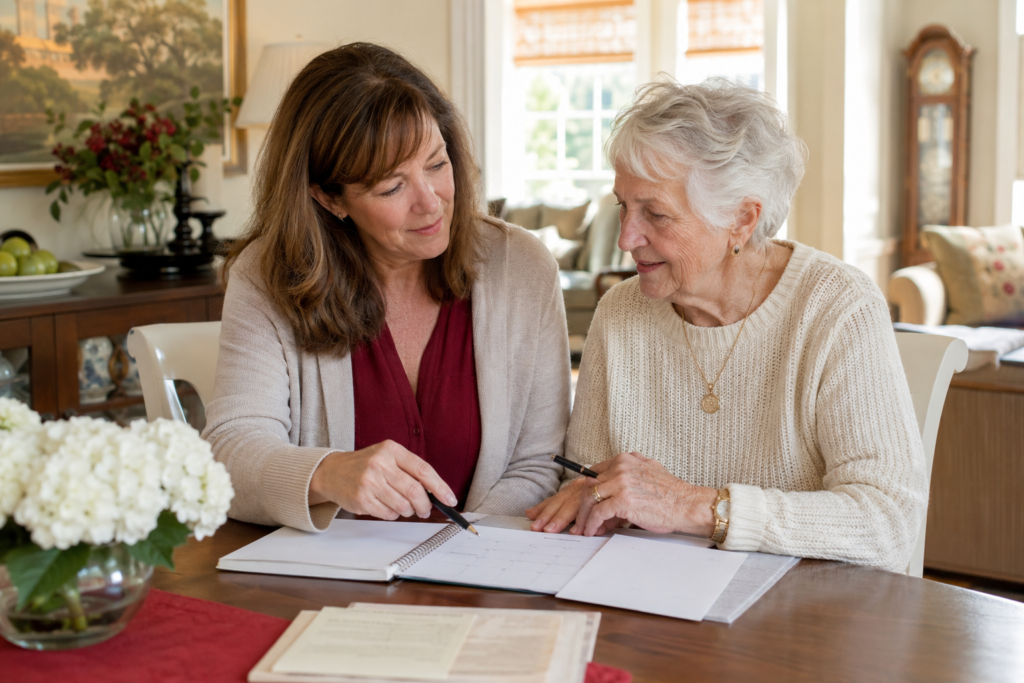
Quick answer: Start the conversation early, in a low-pressure moment, focused on their needs and safety rather than the house itself. Expect it to take more than one conversation. Rushing this talk, or having it during a crisis, is what usually turns it into a fight.
Few conversations feel as loaded as telling a parent it might be time to sell the house they raised you in. It’s not really about square footage or stairs. It’s about independence, memory, and identity. Handled well, this conversation can bring a family closer. Handled poorly, or too late, it can create resentment that outlasts the sale itself.
Why This Conversation Is So Hard
Quick answer: For your parent, the house isn’t just a property. It’s proof of independence. Bringing up selling it can feel like the first sign that others think they can’t manage on their own anymore.
Adult children often approach this conversation focused on logistics: the stairs are a fall risk, the yard is too much to maintain, the house is too far from family. Parents often hear something different: you think I can’t handle my own life anymore.
That mismatch—logistics on one side, identity on the other—is why so many of these conversations go sideways. Understanding that gap before you start talking is half the work.
Signs the Conversation Needs to Happen Soon
Quick answer: Watch for physical struggles with the home itself (stairs, yard, upkeep), not just age. A house that’s become genuinely difficult to manage is a more useful signal than a birthday.
Common signs it’s time to start the conversation:
- Stairs, a large yard, or general upkeep have become physically difficult
- Maintenance and repairs are being put off or ignored
- The home no longer fits their daily needs (isolated location, far from family or medical care)
- They’ve mentioned feeling overwhelmed, lonely, or unsafe, even in passing
- A recent fall, health scare, or hospital stay has made the risks more visible
None of these alone means it’s time to sell, but a few showing up together is usually a sign the conversation shouldn’t wait much longer.
How to Start the Conversation
Quick answer: Pick a calm, unhurried moment and open with curiosity about their life and needs, not a proposal to sell.
A few approaches that tend to work better than a direct pitch:
- Ask before you tell. “How are you feeling about the house these days?” opens the door without putting them on the defensive.
- Talk about their life, not the real estate. Frame it around what they want their day-to-day to look like, not what the house is worth or how fast it could sell.
- Bring it up more than once. This is rarely a one-conversation decision. Planting the idea early and revisiting it gently over weeks or months tends to land better than a single big talk.
- Let them lead the pace. If they’re not ready, pushing harder usually backfires. Reintroducing the topic later, after showing you respect their timeline, often works better than persistence in the moment.
What Not to Say
Quick answer: Avoid ultimatums, comparisons to other elderly relatives, and language that frames the move as something being done to them rather than with them.
A few things that tend to shut the conversation down fast:
- “You have to move, it’s not safe anymore” (ultimatum language)
- “Look what happened to so-and-so who stayed too long” (fear-based comparison)
- Making the decision and informing them, rather than including them in it
- Bringing it up for the first time during a crisis, when emotions are already high
Bringing in Other Family Members Without Causing a Family Fight
Quick answer: Agree among siblings on one point of contact and a shared understanding of the goal before anyone talks to your parent. Mixed messages from multiple family members are one of the fastest ways this turns into conflict.
If you have siblings or other close family involved, get aligned before the conversation happens, not during it:
- Decide who will lead the conversation with your parent
- Agree on what you’re hoping to accomplish (a decision now, or just planting the idea)
- Discuss expectations around helping with logistics, and do it before assuming anyone’s availability or willingness
- Revisit disagreements privately among family, not in front of your parent
When to Loop In a Real Estate Professional
Quick answer: Once your parent is even cautiously open to the idea, a local agent experienced with senior transitions can answer practical questions without the emotional weight a family conversation carries.
Sometimes a parent will ask questions they wouldn’t raise with their own children: What’s the house actually worth? What would need to be fixed first? How long would it take? Bringing in a real estate professional at the right moment can take pressure off the family and give your parent a neutral, informed source to lean on.
Frequently Asked Questions
How do I know if my parent is truly not ready to sell?
If they respond with anger, complete shutdown, or repeated refusal to engage with the topic at all, it’s often a sign the timing — not the idea itself — is the issue. Give it space and revisit later.
What if my siblings disagree about when to sell?
Get aligned privately before involving your parent. Presenting a united, calm front matters more than resolving every disagreement perfectly.
Should I involve my parent’s doctor in this conversation?
If safety is a real concern, a doctor’s perspective can carry weight a family member’s doesn’t — but this works best as one input, not the opening move.
How long does this process usually take, start to decision?
It varies widely, but many families report the idea needs to be introduced and revisited over weeks or months rather than settled in a single conversation.
The Bottom Line
This conversation rarely goes well as a single event — it works better as an ongoing, patient dialogue that respects your parent’s independence while gently addressing real safety and quality-of-life concerns. Starting early, before a crisis forces the issue, gives everyone more room to get it right.
If your family is starting to have this conversation, I can help with the practical side: Answering questions about the home’s value, what it would take to sell, and what the timeline could look like. I make sure your parent has real information, not just family opinions, to work with. Get in touch.
This article reflects general guidance and personal experience and is not medical, legal, or financial advice. Families facing safety concerns should consult a physician or elder care professional.